
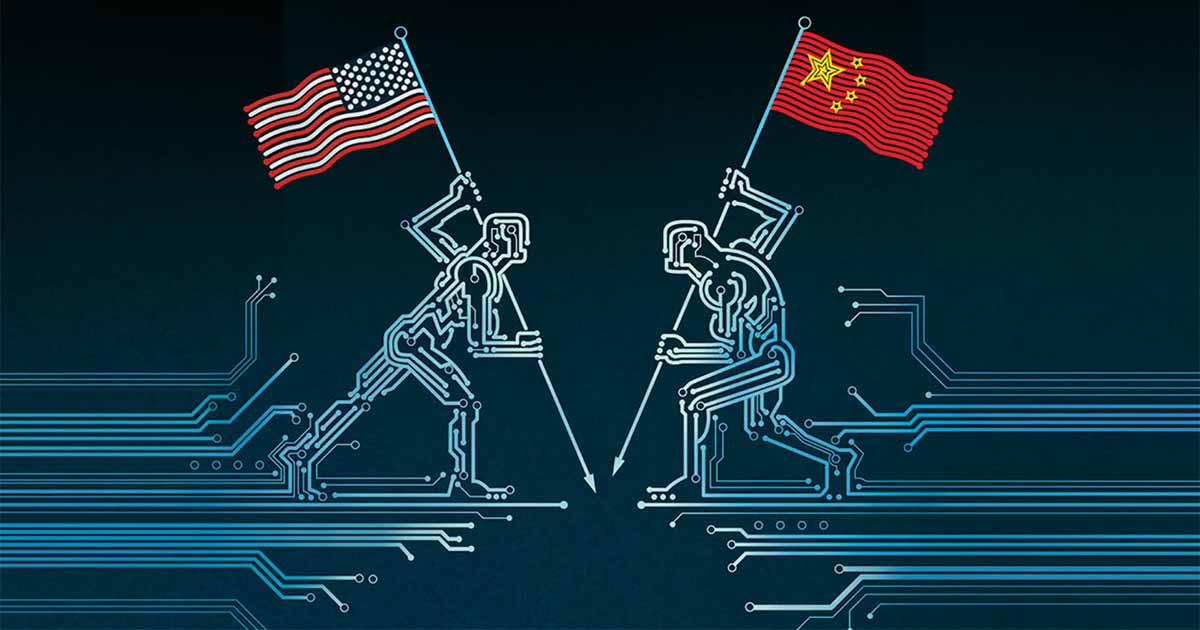
The tech war between the US and China was very intense during the Trump administration that the US sanctioned many Chinese giant companies including Huawei, the top high-tech industry. During his final days in office, Trump also added Semiconductor Manufacturing International Cooperation (SMIC), the Chinese giant chipmaker company, and Shenzhen DJI Sciences and Technologies Ltd (DJI), the Chinese’s top drone maker, to the list.
Though Biden is elected as the President, the US foreign policy will not go soft on China especially on its tension with China over the tech industries. The US in Biden administration would continue to put more pressure on the Chinese tech industries, however, the measures and motivation would be different which the Biden administration would be more diplomatic and follow the international norm and regime before slapping China.

The US will continue to limit the export of advance technology to China because of the involvement of Chinese tech companies in the violation of human rights in Xinjiang regions. As Biden made it clear during his speech at the US state department on 4 January that Democracy and human rights would be the focal point of the his administration.
The speech has included the two pillars of the US foreign policy. First, he stressed the need to work with its allies particularly in Europe and Asia to confront the rise of authoritarian regimes, which is strongly supported by Russia and China. Second, the Biden administration will engage globally which would be “rooted in America’s most cherished democratic values: defending freedom, championing opportunity, upholding universal rights, respecting the rule of law, and treating every person with dignity”. Based on these three pillars of the US would use the human right violation to confront China, particularly the Human right violation in Xinjiang province.
Historically, Biden spearheaded the US intervention abroad including Syria, Libya, and Iraq over the violation of human rights during his time as senator and vice president. The human rights violations in Xinjiang regions would push the US to continue to restrict its export of high-tech components to China. More importantly, the Chinese reeducation camp for the ethnic minorities in northwestern Xinjiang that the Chinese government detained the ethnic minorities most of which are belong to Uighurs. Most Chinese tech industries are accused of involving in providing technical support to the government in oppressing the ethnic minority.

According to the Washington Post, in 2018 Huawei developed a “Uighur Alarm” which is face-scanning surveillance that could help the Chinese government to identify the Uighur ethnic. In 2020, according to The New York Times, the US government added 11 Chinese tech companies who are the component suppliers of US giant tech industries such as Apple, Google, and Ralph Lauren over the involvement of campaign against the Muslim minority in the Xinjiang region.
Most of these companies involved in the use of Uighurs’ labor force to meet its production demand. Two of these companies, Xinjiang Silk Rod BGI and Beijing Liuhe BGI were accused of building genetic analysis with the purpose of suppressing the ethnic minorities in Xinjiang.
Recently, the relations became more complicated after the Alaska summit between Beijing and the Biden administration. The US Secretary of State, Antony Blinken warned China that the US will not stand back in the issue of human rights violations in China particularly on Uighurs and Hong Kong. He also added that such an issue is not an internal affair since it “threatens the rules-based order that maintains global stability. That’s why they are not merely internal matters.”

This tension is clearly shown that the US under the Biden administration would continue to curtail the Chinese access to the US advance technology. Though the US has upper hand on China over the advance technology as China depend on the US input like semiconductor, education, human capital, however, there is also danger for the US as well since the US import around 80 percent of rare earth from China.
In this regards, the US need to diversify its rare supplies so that it would suffer when Chinese government decide to limited its rare earth production. In 2019, the US inked an agreement with Australia Company to build processing rare earth facility in California. However, it would take years for the US to be able to self-reliance on the rare production.

The Author
Sokvy Rim is a Bachelor’s Degree holder in International Relations from Department of International Studies, Institute of Foreign Languages, Royal University of Phnom Penh.